Florida Dog Registration Information
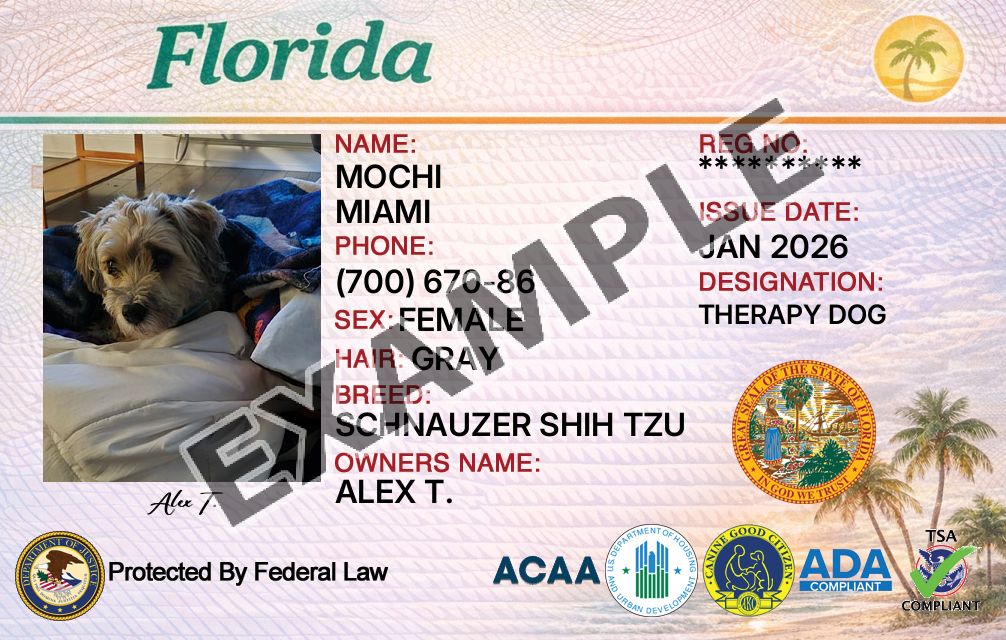
State Licensed, Service Dogs and Emotional Support Dogs in Florida
Where Do I Register My Dog in Florida for a Service Dog or Emotional Support Dog?
If you’re searching where do I register my dog in Florida for my service dog or emotional support dog, the most important thing to know is this: Florida generally does not have one statewide “service dog registry” or “ESA registry” you must (or can) use to make a dog legitimate. What most people mean by “register” is actually getting a dog license in Florida (often issued as a rabies registration tag) through a local county or city animal services program.
In other words, where to register a dog in Florida usually depends on where you live. Your county’s animal services, animal control, or licensing office is typically the place that handles licensing, rabies tag issuance, and enforcement.
Where to Register or License Your Dog in Florida
Because licensing is commonly handled at the county (and sometimes city) level, below are examples of official Florida local government offices that handle pet licensing, rabies tags, or related animal services functions. If your county isn’t listed, look for your county’s “Animal Services,” “Animal Control,” “Pet Licensing,” or “Rabies Tag” program.
Miami-Dade County Animal Services (Pet Adoption and Protection Center)
Orange County Animal Services
Pinellas County Animal Services
Hillsborough County Pet Resource Center (Pet Resources)
Broward County Animal Care Division
Overview of Dog Licensing in Florida
Who handles a dog license in Florida?
Florida does not operate one universal statewide pet licensing office for every resident. Instead, most animal control dog license Florida programs are managed by county animal services, sometimes in coordination with local municipalities or contracted partners (such as participating veterinary offices for tag sales). This is why the answer to where to register a dog in Florida is usually: your county animal services / pet licensing office.
What the “license” usually is
In many Florida counties, the license is effectively a rabies registration tag (a tag number tied to your dog and your contact information) and/or a county-issued pet registration record. The exact rules (age threshold, renewal timing, and fees) vary by county ordinance.
Why counties require licensing
Dog licensing supports public health and safety, helps animal control return lost pets, and can help fund shelter and enforcement services. Even if your dog is a service dog or emotional support animal, you may still be expected to follow local licensing and vaccination rules.
How Dog Licensing Works Locally in Florida
Step 1: Confirm your county’s licensing rule
Start with your county government’s animal services/animal control program. Florida counties can differ on: required vs. optional licensing, where you can purchase tags (county office vs. participating vets), tag duration, and whether fees change based on spay/neuter status. If you recently moved, verify in the county where you currently live (not where your dog was previously licensed).
Step 2: Get rabies vaccination (or a veterinarian exemption if medically necessary)
Florida law requires dogs, cats, and ferrets 4 months of age or older to be vaccinated against rabies by a licensed veterinarian, with revaccination intervals based on the initial shot and the vaccine manufacturer’s directions. Florida law also allows a written veterinary exemption when vaccination would endanger the animal’s health due to medical considerations.
Step 3: Bring your paperwork to the correct office (or approved sales point)
Counties commonly ask for proof of rabies vaccination (rabies certificate) and owner identification. Some counties allow licensing through: the animal services office, mail-in submissions, online portals, or approved veterinary offices. If you’re unsure, call the office and ask: “How do I obtain a rabies tag / pet license, and what documents do you require?”
Step 4: Renew and keep records accessible
Renewal frequency varies by county. Keep a copy of your rabies certificate and licensing receipt in a safe place, and keep your dog’s tag current and attached to the collar if required by local ordinance. If animal control contacts you, having documentation ready can save time and stress.
Service Dog Laws in Florida
A service dog is defined by training and tasks—not registration
Under U.S. disability law (including ADA rules for public places), a service animal is a dog trained to perform tasks directly related to a person’s disability. Importantly, service animals are not required to be certified, registered, or to wear a vest to be legitimate as service animals. This is a major reason people get confused when asking: where do I register my dog in Florida for my service dog—because the “registration” that matters legally is the dog’s training and role, not a card or database entry.
What staff may ask you in public settings
If it’s not obvious that a dog is a service animal, businesses and government facilities are generally limited to asking two questions: (1) whether the dog is a service animal required because of a disability, and (2) what work or task the dog has been trained to perform. They generally may not require documentation that the dog is “registered” or “certified,” and they may not ask about the nature of the disability.
Do service dogs still need a dog license in Florida?
In many counties, yes. A service dog may still need to comply with local licensing and rabies vaccination rules like any other dog. Think of it as two separate systems: local public health/animal control rules (licensing) and disability access rights (service dog status).
Emotional Support Animal Rules in Florida
An emotional support animal is not a service dog
An emotional support animal (ESA) generally provides comfort by presence and does not have to be trained to perform tasks. Because ESAs do not meet the ADA’s task-training definition of a service animal, they typically do not have the same public-access rights as service dogs in restaurants, stores, or other public accommodations.
Florida’s ESA rules mainly matter in housing
In Florida, ESA-related disputes most often come up with landlords, HOAs/condos, and other housing providers—where a person requests a reasonable accommodation to keep an animal despite “no pets” rules. Florida law defines emotional support animals and addresses housing-provider conduct around these requests.
“ESA registration” vs. local licensing
If you’re asking where do I register my dog in Florida for my emotional support dog, the practical answer is often: you usually license the dog locally through your county (rabies tag / pet license), and you handle ESA status separately through proper housing accommodation documentation when needed. A county pet license is not the same thing as an ESA accommodation, but it can still be required.
Frequently Asked Questions
What You May Need
- rabies vaccination proof
- identification
- proof of residency
- licensing fee
Quick Summary: The Best Answer for Most People
If you’re still asking, where do I register my dog in Florida for my service dog or emotional support dog, here’s the practical checklist:
- License your dog locally (county/city animal services). This is your typical dog license in Florida process and may be called a rabies registration tag.
- Keep rabies vaccination current and retain your rabies certificate (or veterinary exemption if applicable).
- For a service dog, focus on the dog being trained to perform disability-related tasks. Public access rights are not created by buying a registration card.
- For an emotional support animal, focus on the housing accommodation process when needed—separate from local licensing.
Register A Dog In Other Florida Counties
Select your county from the dropdown below to get started with your dog’s ID card. Requirements and license designs may vary by county, so choose your location to see the correct options and complete your pup’s registration.
- Alachua County Dog Registration
- Baker County Dog Registration
- Bay County Dog Registration
- Bradford County Dog Registration
- Brevard County Dog Registration
- Broward County Dog Registration
- Calhoun County Dog Registration
- Charlotte County Dog Registration
- Citrus County Dog Registration
- City of Jacksonville County Dog Registration
- Clay County Dog Registration
- Collier County Dog Registration
- Columbia County Dog Registration
- DeSoto County Dog Registration
- Dixie County Dog Registration
- Duval County Dog Registration
- Escambia County Dog Registration
- Flagler County Dog Registration
- Franklin County Dog Registration
- Gadsden County Dog Registration
- Gilchrist County Dog Registration
- Glades County Dog Registration
- Gulf County Dog Registration
- Hamilton County Dog Registration
- Hardee County Dog Registration
- Hendry County Dog Registration
- Hernando County Dog Registration
- Highlands County Dog Registration
- Hillsborough County Dog Registration
- Holmes County Dog Registration
- Indian River County Dog Registration
- Jackson County Dog Registration
- Jefferson County Dog Registration
- Lafayette County Dog Registration
- Lake County Dog Registration
- Lee County Dog Registration
- Leon County Dog Registration
- Levy County Dog Registration
- Liberty County Dog Registration
- Madison County Dog Registration
- Manatee County Dog Registration
- Marion County Dog Registration
- Martin County Dog Registration
- Miami-Dade County Dog Registration
- Monroe County Dog Registration
- Nassau County Dog Registration
- Okaloosa County Dog Registration
- Okeechobee County Dog Registration
- Orange County Dog Registration
- Osecola County Dog Registration
- Palm Beach County Dog Registration
- Pasco County Dog Registration
- Pinellas County Dog Registration
- Polk County Dog Registration
- Putnam County Dog Registration
- Santa Rosa County Dog Registration
- Sarasota County Dog Registration
- Seminole County Dog Registration
- St. Johns County Dog Registration
- St. Lucie County Dog Registration
- Sumter County Dog Registration
- Suwannee County Dog Registration
- Taylor County Dog Registration
- Union County Dog Registration
- Volusia County Dog Registration
- Wakulla County Dog Registration
- Walton County Dog Registration
- Washington County Dog Registration