Florida Dog Registration Information
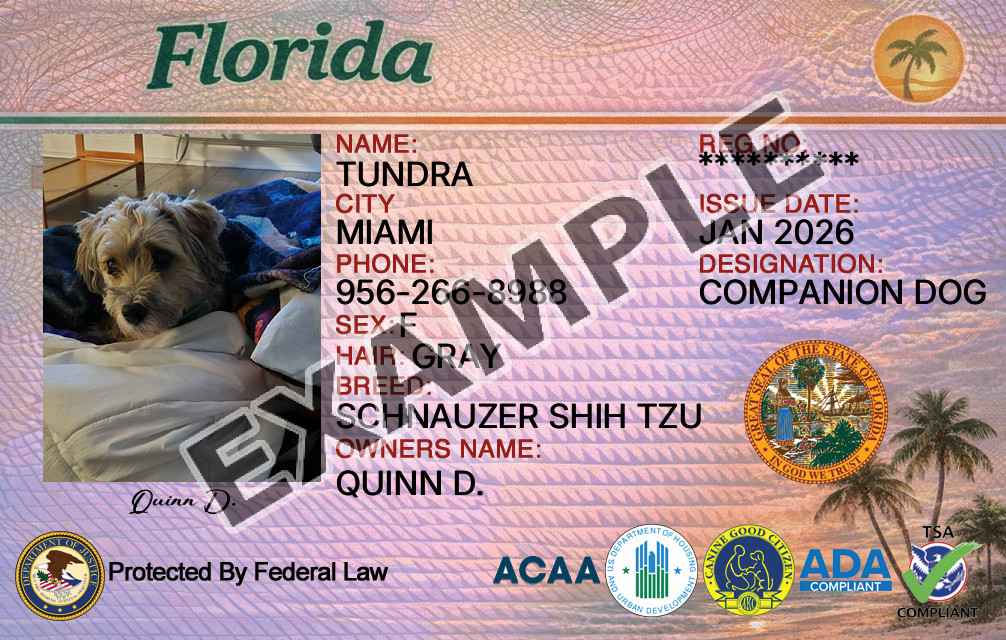
State Licensed, Service Dogs and Emotional Support Dogs in Florida
If you’re searching for where do I register my dog in Florida for my service dog or emotional support dog, the key thing to know is this: Florida does not have one single statewide “service dog registry” or “emotional support dog registration” office for the public. Instead, most residents who need to “register” their dog are really looking for a dog license in Florida (often issued as a county or city tag) tied to rabies vaccination and local animal control rules.
- In Florida, dog licensing is usually handled locally (county animal services, animal control, or sometimes a city/county tax collector).
- A dog license (rabies/license tag) is different from a dog’s service dog legal status under the ADA, and different from an emotional support animal accommodation in housing.
- Avoid “registration” websites that sell certificates or IDs. They are not required for public access rights under federal law.
Where to Register or License Your Dog in Florida
Because animal control dog license Florida requirements are commonly set by county (and sometimes city) ordinance, you’ll typically register/license your dog through the animal services department where you live. Below are several example official offices in Florida that handle pet licensing, rabies tags, or animal control enforcement. If an item is not shown, it wasn’t available from the office’s published contact information at the time of writing.
Hillsborough County Pet Resources (Pet Resource Center)
Orange County Animal Services
Palm Beach County Animal Care and Control
City of Jacksonville Animal Care & Protective Services (ACPS)
Overview of Dog Licensing in Florida
What “registering your dog” usually means in Florida
In everyday terms, when people ask where to register a dog in Florida, they’re usually referring to obtaining a local license tag (often called a rabies tag, registration tag, or county license tag). Many Florida counties require a current rabies vaccination and a local tag for dogs (often for dogs at or above a certain age threshold set by local ordinance). The purpose is public health and accountability: it helps animal control identify an owned dog quickly, track vaccination status, and enforce rabies-related rules.
Who enforces licensing and rabies rules?
Florida’s dog licensing and rabies enforcement is largely carried out at the local level by county or city agencies such as Animal Services, Animal Care & Control, or Animal Care & Protective Services. These agencies may operate shelters, investigate bite cases, handle nuisance/at-large complaints, and ensure compliance with vaccination and licensing rules. In some areas (for example, Jacksonville), the process can involve a city program and/or the tax collector depending on how the local system is set up.
Rabies vaccination and tag basics
Rabies vaccination is central to most local licensing programs. Some Florida jurisdictions explicitly tie the license tag to proof of rabies vaccination and require that the tag be attached to the dog’s collar. The exact timing and renewal cycle can depend on your county rules and the duration of your dog’s rabies vaccine. If you’re trying to get compliant fast, a good starting point is: schedule a rabies vaccination (or obtain a copy of the current rabies certificate from your veterinarian), then contact your local animal services office about purchasing or renewing the local tag.
How Dog Licensing Works Locally in Florida
Step 1: Identify the correct local office
To figure out where to register a dog in Florida in your specific area, start with your county (and then your city, if applicable). Most Florida residents will work with a county animal services department. In a smaller number of places, you may be directed to a tax collector’s office or a city-run program. The “Where to Register or License Your Dog in Florida” section above includes examples of official offices you can compare to your own county’s structure.
Step 2: Confirm what documents your county requires
While requirements vary, local programs commonly ask for:
- Proof of current rabies vaccination (rabies certificate from a veterinarian)
- Owner identification (such as a driver’s license or other ID)
- Proof of residency (especially if the license is discounted for county residents)
- Payment of the licensing fee (fees may differ based on spay/neuter status, duration, and local policy)
Step 3: Choose the method (in person, by mail, or online)
Some Florida counties allow licensing transactions at an animal services counter, by mail, through partner locations, or through an official online portal. If you are specifically looking for an animal control dog license Florida process, focus on the official county/city channels (not vendors selling “registrations”). If you’re unsure, call the office and ask: “Do you issue rabies/license tags, and what do you need from me to obtain a dog license in Florida for my county?”
If your dog is a service dog or ESA, do you still need a local license?
In many places, yes. A dog’s role as a service dog or emotional support animal usually does not replace local public health rules around rabies vaccination and licensing. Think of it as two different tracks:
- Local compliance track: rabies vaccination + county/city license tag
- Legal status track: service dog public-access rights (ADA) or ESA housing accommodation (Fair Housing)
If you’re trying to be fully compliant, do both: keep your dog’s license current and keep the documentation appropriate to your situation (for example, vaccination records; for ESAs in housing, the documentation your housing provider may request).
Service Dog Laws in Florida
Service dogs are not “registered” by the state for public access
Under the Americans with Disabilities Act (ADA), service animals are defined by training to do work or perform tasks for a person with a disability. Importantly, the ADA does not require a special card, certificate, vest, or online registration for a service dog. That means if you’re searching “where do I register my dog in Florida for my service dog,” the answer for public access rights is typically: you don’t register the dog with a state service-dog registry. You follow your county’s licensing rules (rabies/tag) and rely on ADA rules for access.
What businesses can ask (and what they can’t)
When it’s not obvious a dog is a service dog, staff are generally limited to two questions under ADA guidance:
- Is the dog a service animal required because of a disability?
- What work or task has the dog been trained to perform?
Staff generally cannot demand medical records, require special documentation, or ask for the dog to demonstrate the task. Even with a legitimate service dog, the handler must keep the dog under control and the dog must be housebroken.
Local tags still matter
Even though the ADA does not require registration, your county may still require a local dog license in Florida (rabies/license tag). Keeping a current tag and rabies certificate can help avoid misunderstandings if animal control becomes involved (lost dog, bite incident, disaster sheltering rules, etc.).
Emotional Support Animal Rules in Florida
ESAs are not the same as service dogs
An emotional support animal (ESA) provides comfort that helps with a person’s disability, but ESAs are not automatically service animals under the ADA because they are not necessarily trained to perform a specific task. This is one of the biggest reasons people get confused when asking where to register a dog in Florida for an ESA: there usually isn’t a public “ESA registration” that grants you the right to bring the dog into restaurants, stores, or other public places.
Where ESAs are most relevant: housing
ESAs most commonly come up in housing under fair housing rules. Federal housing guidance generally discusses “assistance animals,” which can include animals that perform tasks or provide emotional support that alleviates one or more effects of a person’s disability. Housing providers may have a process for requesting a reasonable accommodation, and may request information when the disability or disability-related need is not obvious.
What to do instead of “ESA registration”
If you need an ESA accommodation for housing, focus on your housing provider’s reasonable accommodation process and keep your dog compliant with local public health rules. For local compliance, you still follow the county/city requirements for a dog license in Florida, including rabies vaccination and any required tags.
Frequently Asked Questions
Do I need to register my service dog in Florida?
For public access rights, you typically do not register a service dog with a Florida statewide “service dog registry.” What you usually must do is comply with your local licensing rules (rabies vaccination and any required county/city tag) and follow ADA rules for service animals in public places.
Do I need to register my emotional support dog (ESA) in Florida?
ESAs generally aren’t “registered” with the government for public access. If you need an ESA for housing, you typically request a reasonable accommodation through your housing provider’s process. Separately, you still handle your local dog license in Florida through your county or city.
Where do I actually go to get a dog license in Florida?
In most cases, you go to your county animal services / animal control office (or the local office they direct you to). The example offices above (Hillsborough County Pet Resources, Orange County Animal Services, Palm Beach County Animal Care and Control, and Jacksonville ACPS) show the typical types of agencies involved.
Is a rabies tag the same thing as a license tag?
They are often connected. Many local governments issue a tag as proof that the dog is licensed and that rabies vaccination requirements have been met. Terminology varies: you may hear “rabies tag,” “county tag,” “pet registration tag,” or “license tag.”
Will an online “registry” make my dog a service dog or ESA?
No. Service dog status is based on disability-related need and training to perform tasks under the ADA, not on buying a certificate. ESA accommodations in housing generally depend on a disability-related need and the housing provider’s accommodation process, not a purchased registry document. If you’re trying to stay compliant, prioritize the official local licensing route (animal control dog license Florida) and the correct legal framework for service dogs or ESAs.
Register A Dog In Other Florida Counties
Select your county from the dropdown below to get started with your dog’s ID card. Requirements and license designs may vary by county, so choose your location to see the correct options and complete your pup’s registration.
- Alachua Dog License Cards
- Baker Dog License Cards
- Bay Dog License Cards
- Bradford Dog License Cards
- Brevard Dog License Cards
- Broward Dog License Cards
- Calhoun Dog License Cards
- Charlotte Dog License Cards
- Citrus Dog License Cards
- City of Jacksonville Dog License Cards
- Clay Dog License Cards
- Collier Dog License Cards
- Columbia Dog License Cards
- DeSoto Dog License Cards
- Dixie Dog License Cards
- Duval Dog License Cards
- Escambia Dog License Cards
- Flagler Dog License Cards
- Franklin Dog License Cards
- Gadsden Dog License Cards
- Gilchrist Dog License Cards
- Glades Dog License Cards
- Gulf Dog License Cards
- Hamilton Dog License Cards
- Hardee Dog License Cards
- Hendry Dog License Cards
- Hernando Dog License Cards
- Highlands Dog License Cards
- Hillsborough Dog License Cards
- Holmes Dog License Cards
- Indian River Dog License Cards
- Jackson Dog License Cards
- Jefferson Dog License Cards
- Lafayette Dog License Cards
- Lake Dog License Cards
- Lee Dog License Cards
- Leon Dog License Cards
- Levy Dog License Cards
- Liberty Dog License Cards
- Madison Dog License Cards
- Manatee Dog License Cards
- Marion Dog License Cards
- Martin Dog License Cards
- Miami-Dade Dog License Cards
- Monroe Dog License Cards
- Nassau Dog License Cards
- Okaloosa Dog License Cards
- Okeechobee Dog License Cards
- Orange Dog License Cards
- Osecola Dog License Cards
- Palm Beach Dog License Cards
- Pasco Dog License Cards
- Pinellas Dog License Cards
- Polk Dog License Cards
- Putnam Dog License Cards
- Santa Rosa Dog License Cards
- Sarasota Dog License Cards
- Seminole Dog License Cards
- St. Johns Dog License Cards
- St. Lucie Dog License Cards
- Sumter Dog License Cards
- Suwannee Dog License Cards
- Taylor Dog License Cards
- Union Dog License Cards
- Volusia Dog License Cards
- Wakulla Dog License Cards
- Walton Dog License Cards
- Washington Dog License Cards
